
Parking isn’t controversial when you plan it... It becomes controversial the moment you (try) to take it away. Here’s why, where our parking numbers actually came from, and who’s really paying for all that “free” parking.*
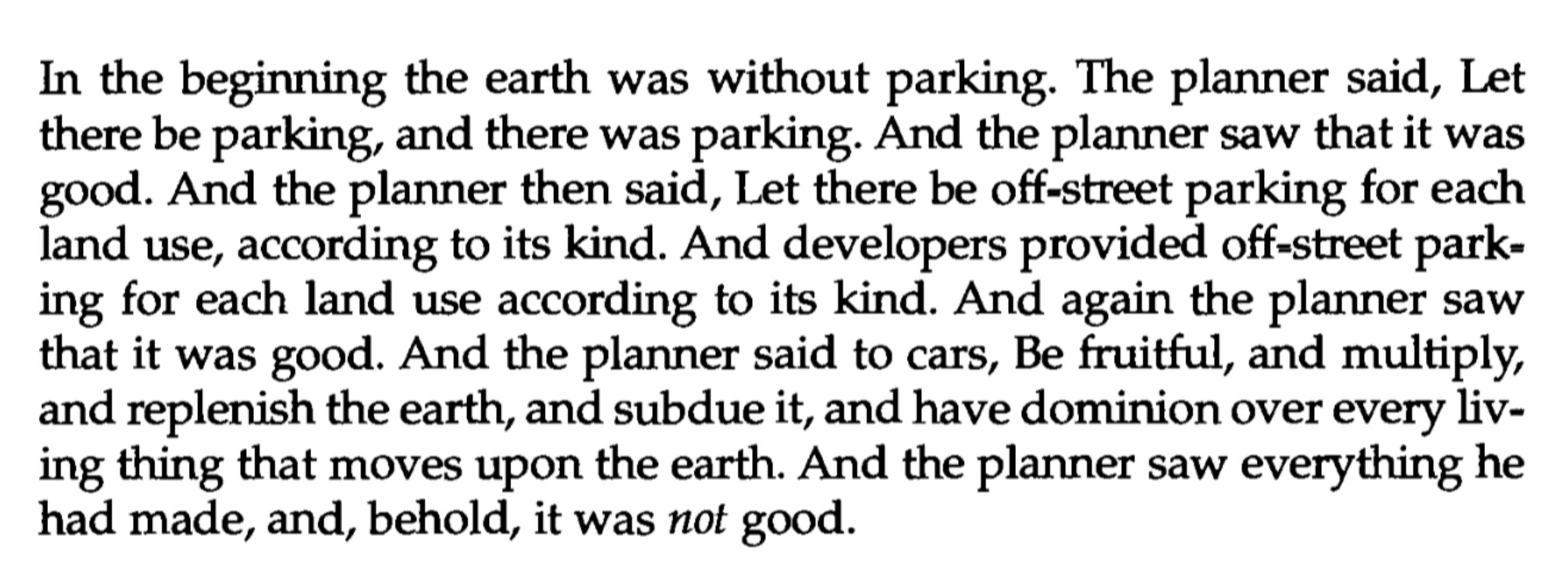
There’s a little editorializing in there about how certain planners feel about parking. But if you get past the comedy, there’s a lot of truth in it.
How much parking do we have? Do you think it’s enough?
I opened my class with a quick poll. How many parking spaces are on Georgia Tech’s campus? The guesses ran from close to zero all the way to 25,000 (that was the upper bound on the poll). The answer, as of the last study in 2019, is about 12,500. And at the busiest time on the busiest day, about 73% of them are occupied. That’s roughly 3,400 empty spaces at peak, the equivalent of nearly 18 football fields (but don’t get me started about Georgia Tech’s football team).
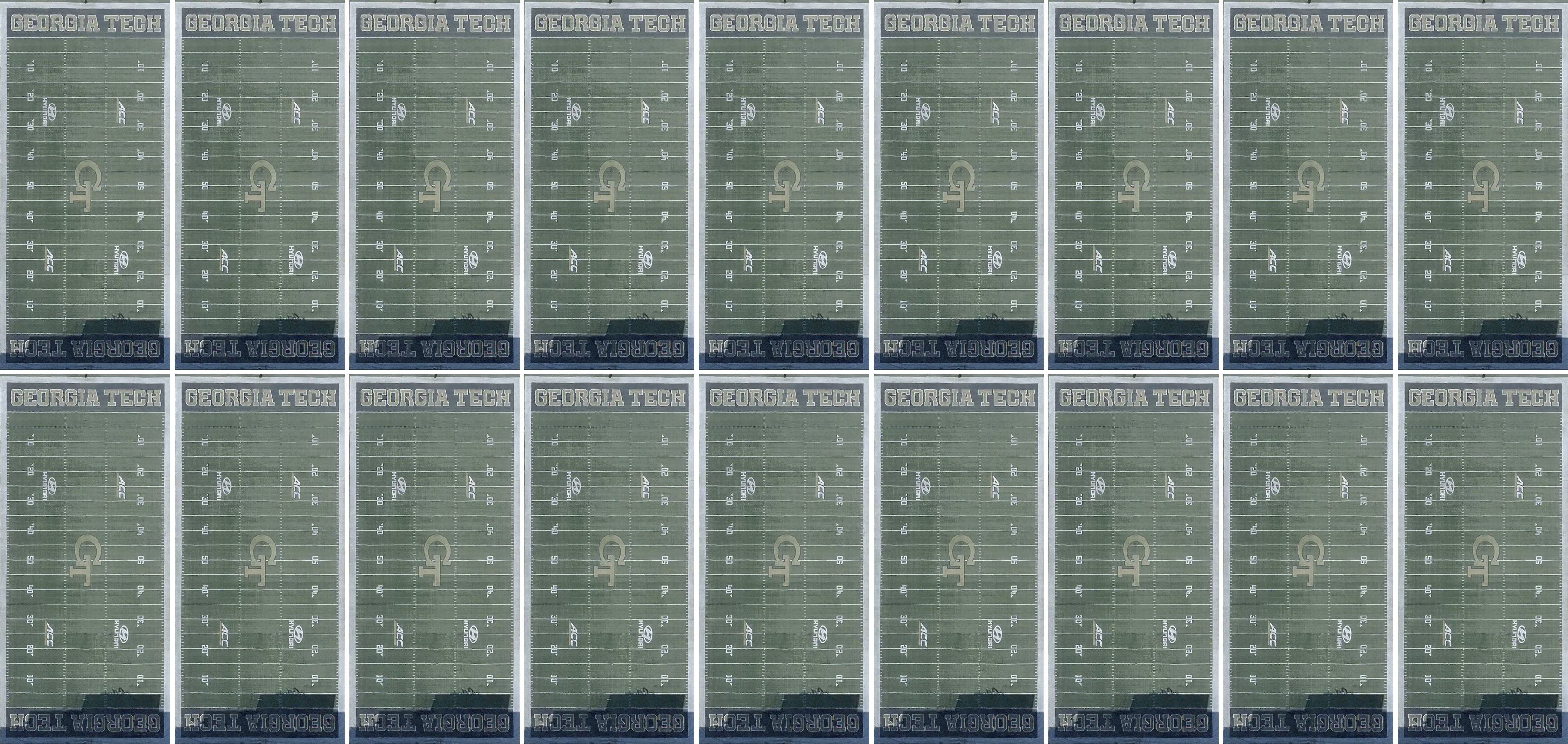
I then asked (anonymously), “how many of you feel like we need MORE parking on campus?” And 20% still said yes (despite being in my very progressive transportation class!)
Here’s the thing. Occupancy gets measured across a whole campus (or city), but people’s preferences are local. People want to park as close as possible to where they’re going. A garage at 73% can feel completely full if the ground floor is packed and the top three floors are empty. That shouldn’t be the expectation, but over time it’s become the standard.
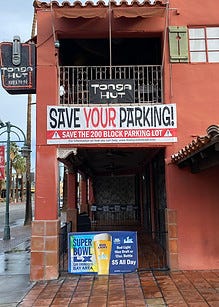
Why do people get so upset about parking?
Every transportation system has three parts: vehicles, rights-of-way, and terminals. Planes have air corridors and airports. Trains have tracks and stations. So what makes cars different? It’s a small thing, but it adds up fast. Lots of people own one, and we’ve come to expect a place to put it at both ends of every trip. Multiply that by everyone, and that’s why parking takes up so much space.
Parking politics are hard (nay, completely irrational) for two reasons. First, we’ve spent decades setting an expectation that parking shall be free and immediately accessible. And people remember the one time they circled the block for fifteen minutes, not the hundred times they pulled right in. They’ll carry that one story to every public meeting for years.
Some people see public parking for what it is: subsidized storage for private vehicles. Whether that’s good public policy is a fair question. But more than once, I’ve seen the opposite happen. People take that subsidy to heart and start to believe that publicly accessible parking actually belongs to them.
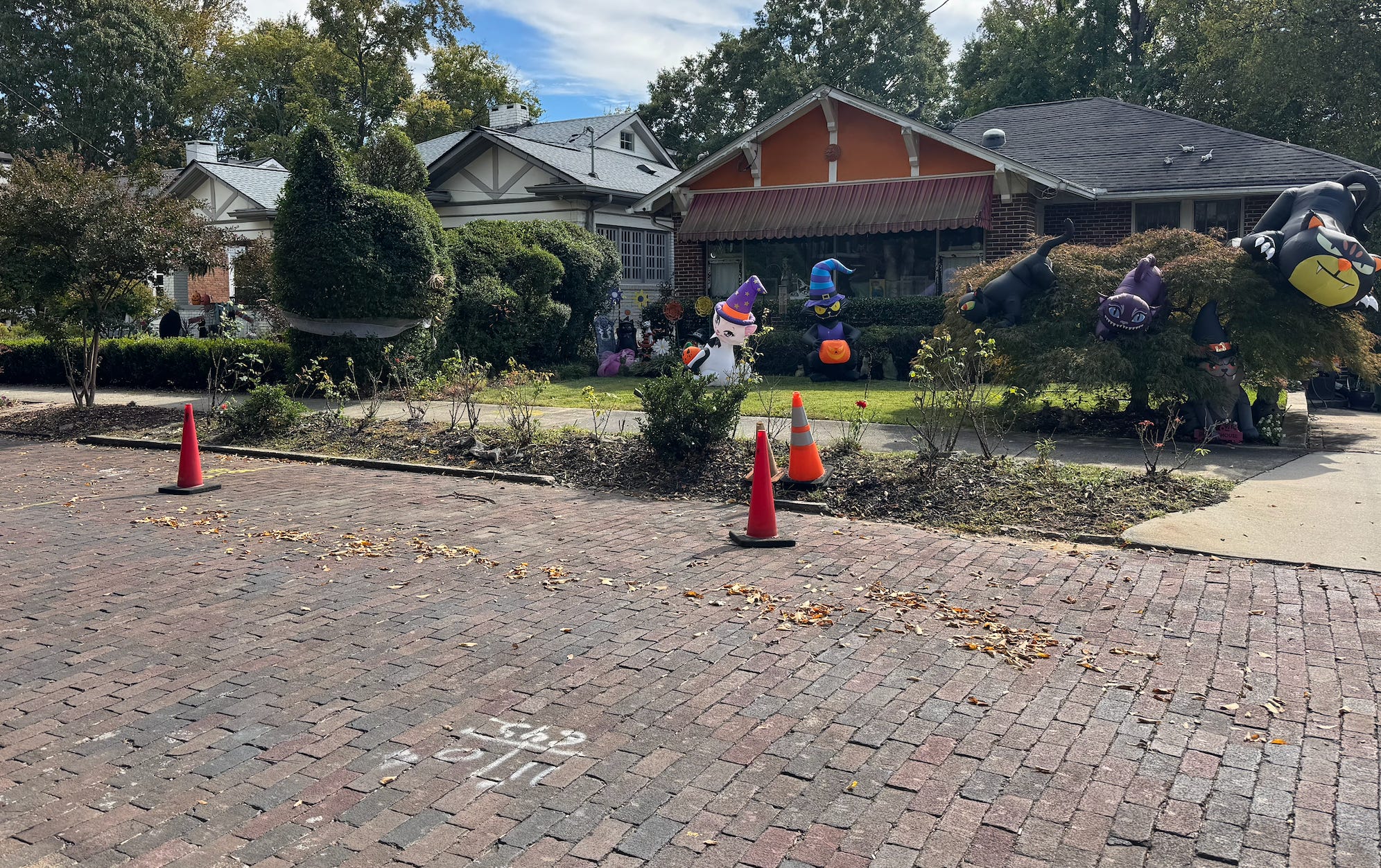
Second, loss aversion. Losing something feels about twice as bad as gaining the same thing feels good. So losing a few parking spaces, for a protected bike lane, safety improvements, or a fire station, always seems to be an uphill battle. That’s why when it comes to public sentiment, nobody shows up when we plan for parking. They show up when they think they’re losing it.
My favorite story for this comes from a sociology study done right here in Atlanta with the greatest of names: “Territorial Defense in Parking Lots: Retaliation Against Waiting Drivers” (Ruback and Juieng, 1997). Researchers sat in mall parking lots and timed how long people took to pull out after getting in their car. With nobody waiting, it took about 27 seconds. With someone quietly waiting for the space, about 31. When the waiting driver honked, it was about 43.
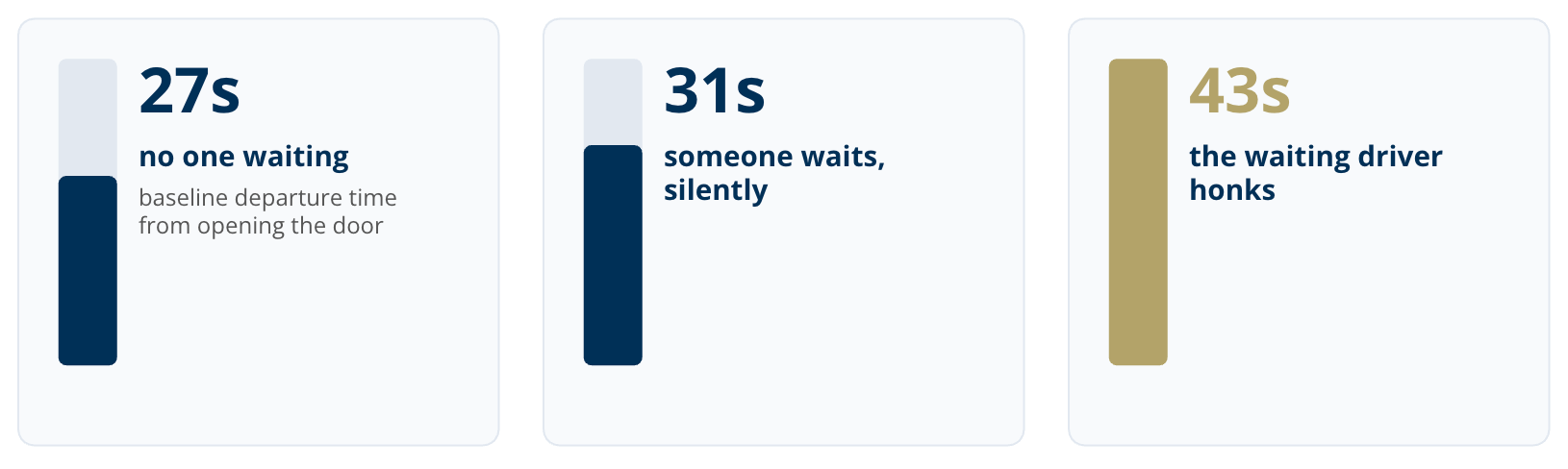
What makes this so interesting is that the shoppers are done shopping. The space is worth nothing to them anymore. Staying longer only costs them time. They stay anyway.
So where did the numbers come from?
When a new shopping center gets built, how is the number of parking spaces decided? A lot of the time, it comes from the Institute of Transportation Engineers’ *Parking Generation* manual. And to be fair, in the ’50s and ’60s this was a completely reasonable idea. Nobody knew how much parking a new building needed. So they measured some real places, drew a line through the data, and published it.
But it breaks in a few places. The samples were small and mostly suburban, with no transit, so the numbers became a self-fulfilling prophecy. The precision suggests an accuracy that isn’t there. And it plans for the peak of the peak. We size the whole lot for the one hour before Christmas, and it sits empty in February.
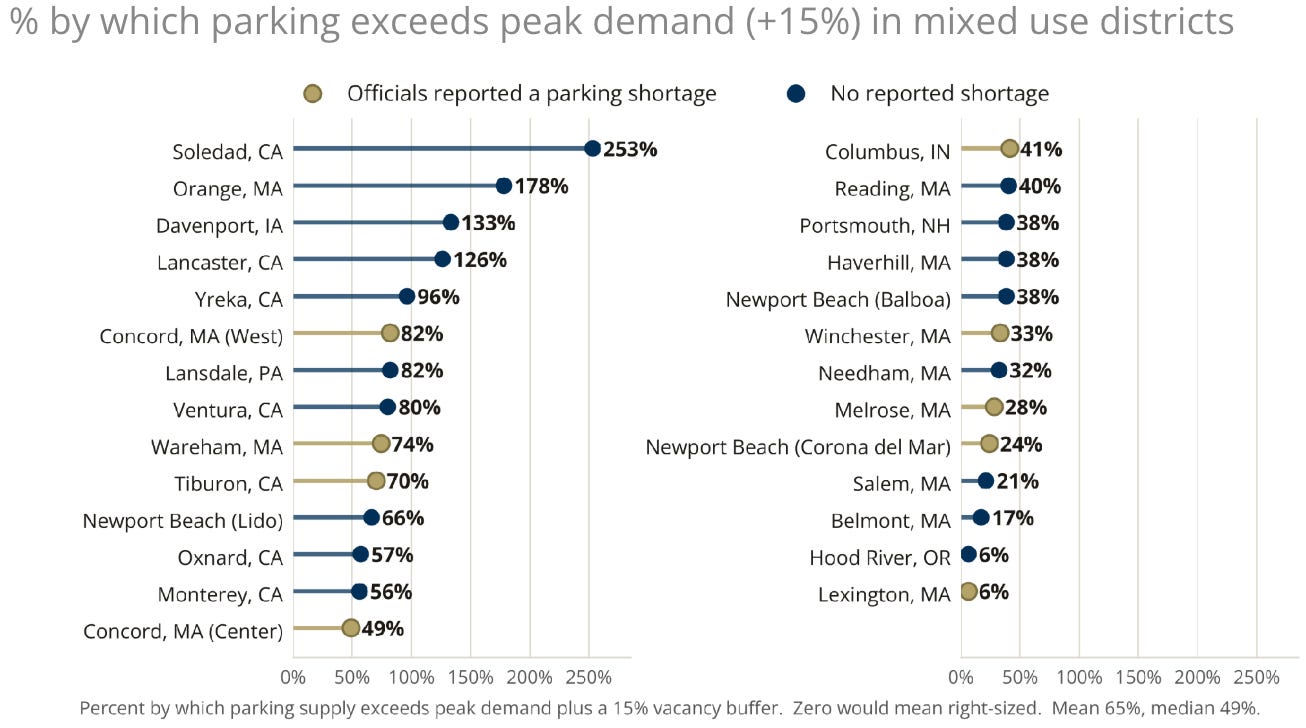
You can see the result in the field. Dr. Rachel Weinberger and Joshua Karlin-Resnick went back through 27 mixed-use districts studied by Nelson\Nygaard. Even after giving each district a 15% cushion above peak demand, every single one had more parking than it needed. Soledad, California had 253% more. Nine of those studies happened because local officials believed they had a shortage. All nine were oversupplied too.
And it plays out here at Georgia Tech. The 2009 campus master plan estimated we’d need about 13,000 spaces by 2019, which meant building 2,500 more. In 2019, measured peak demand was about 9,100. The forecast overshot by about 43%. Georgia Tech didn’t build all those spaces, and nobody was being careless. That’s just how conservative this approach is.
How a downtown becomes a parking lot
Now play that logic out over decades in a downtown. In the 1950s, there are no parking requirements. Then the code says one space per 1,000 square feet, and later more. Nothing changes overnight. But every time an old building gets redeveloped, the new project has to fit its required parking on the same lot. Slowly, building by building, the dense downtown turns into a checkerboard: some buildings, a lot of parking.
*A modeled 24-block downtown core before parking requirements (1952) and after decades of rising minimums (2014). Light gray is surface parking, hatched is structured parking. From my “How a Downtown Becomes a Parking Lot” explainer on civicmotion.org.
Parking is hella expensive
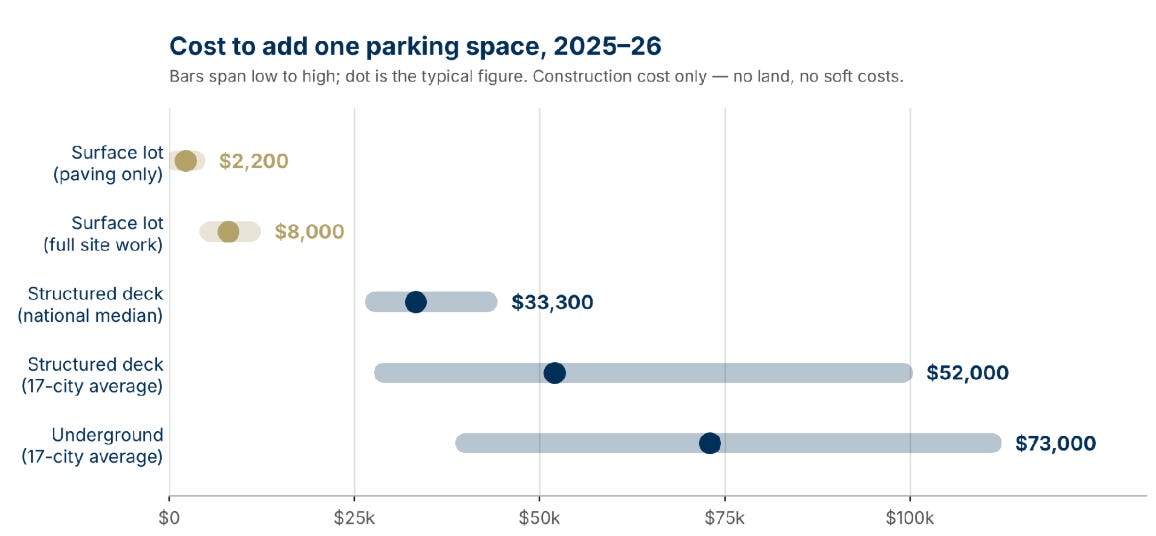
One thing’s clear: people forget what parking costs to build (let alone the externalities). The Center for Parking Policy at UCLA continues to advance research and capture great industry data on this topic. A structured parking space costs somewhere between $33,000 (WGI) and $52,000 (UCLA) to build today, before you count the land. Something as simple as a paved surface lot was found to be about $2,000 per space, so take a 500-space lot, that’s a fast million in capital costs to store a gaggle of depreciating assets (at a 2026 average of $50k per pop).
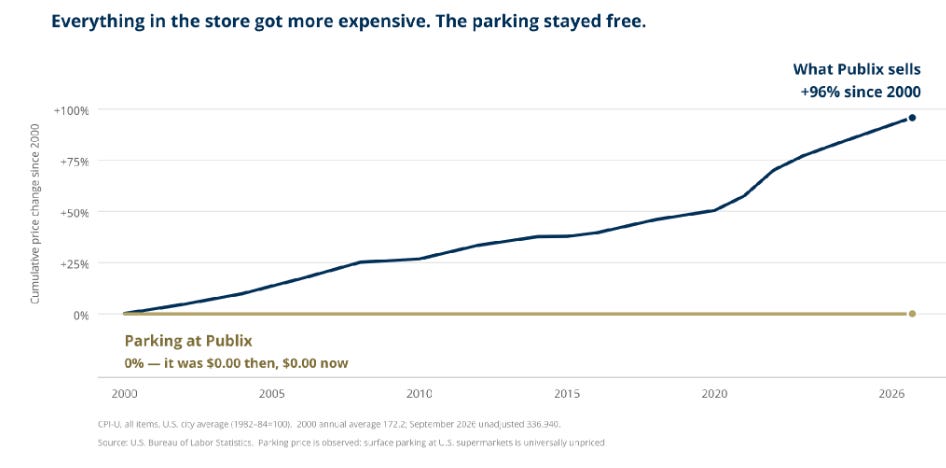
In class, I then brought up a sort of snarky example explaining how the price for parking at Publix (or any major retailer) changed since 2000. SPOILER ALERT: consumer prices are up 96%. Parking at major retailers went from free to free.
So what do planners do about it? Change the supply, or change the demand. Buffalo and Seattle removed parking minimums, and developers built a lot less parking. On the flip side, in D.C. and Grand Rapids, developers kept building more than the old minimum anyway. That’s worth flagging: removing a minimum doesn’t ban parking. It just lets the market decide how much parking is actually needed, instead of forcing it to be built. On the demand side, you can price the curb, the way San Francisco adjusts meter rates block by block to keep a space or two open.
Next time you pull into a “free” lot, ask yourself who paid for it. Because somebody did.
In the meantime, please feel free to enjoy this interactive explainer on on-street parking pricing!